• Skip to main content
  • Skip to primary sidebar

Actions and Indications

nursing, etc.

The Adverse-Decision Machine

May 17, 2026 by David Glenn

“It was very clear that the system was set up to make things difficult for me.” 

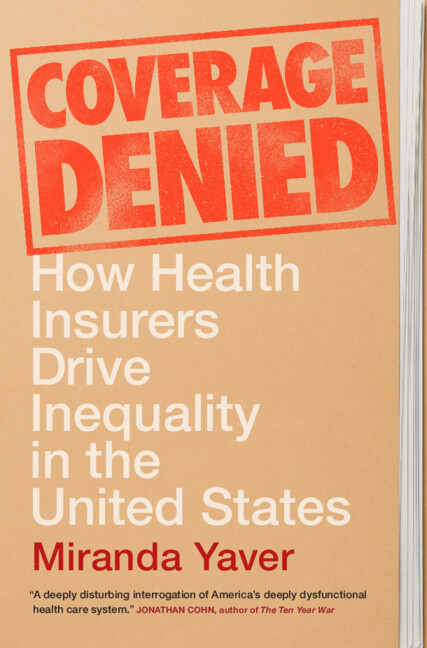
Those are the words of a D.C. woman who found herself struggling to get a birth-control prescription for dysmenorrhea — the simplest, most basic kind of claim — authorized by her insurer (UnitedHealthcare, if you’re wondering). She’s one of hundreds of people interviewed by Miranda Yaver, a health policy scholar at the U. of Pittsburgh, for Coverage Denied: How Health Insurers Drive Inequality in the United States (Cambridge U. Press, 2026).

The number of health claim denials has exploded over the last decade — and, as Yaver’s subtitle suggests, the effects of those denials are unevenly felt. The D.C. woman struggling with the birth-control denial happened to be relatively affluent, with multiple postgraduate degrees. After six weeks of phone calls and paperwork, she was able to wring some justice out of her insurer. But Yaver’s research shows that people with lower incomes and less education are less likely to appeal their denials, and less likely to be aware of the fact that appeals often succeed. Among people who’ve had a claim denied, people with relatively low incomes and relatively unstable employment are more likely to report that they’ve postponed medical care because of that denial. 
Over the last fifteen years, the U.S. has done a decent job of reducing the number of people who are completely uninsured. But before we get too excited about that: As Yaver demonstrates, U.S. health insurance remains an engine of inequality even for people who are inside its tent.

Yaver places her argument in the tradition of scholarship on “administrative burden” — the paperwork and other bureaucratic hassles that (often by tacit design) prevent people from getting care they’re legally entitled to. Most of the literature on administrative burden focuses on applicants’ struggles to get enrolled or maintain enrollment in public programs such as Medicaid or TANF. Yaver’s book focuses on a different strain of administrative burden: the struggles of people who are fully enrolled in health insurance — often paying hundreds of dollars a month in premiums for the privilege — to receive the benefits to which they’re ostensibly entitled.

Those struggles are getting worse. The fragmentation of U.S. health insurance makes it hard to report clean numbers, but the pattern is clear. Whether we look at employer-provided insurance, ACA plans, privately-administered Medicaid plans, or Medicare Advantage, patients are finding their claims denied at enormous rates. One widely cited study by KFF found that in 2023, twenty percent of claims filed by patients on ACA marketplace plans were denied. When patients appealed those denials (and only a tiny fraction of them did file appeals), they prevailed 44 percent of the time.

That 44-percent reversal rate strongly suggests that, to a large extent, insurers are flinging denials at the wall to see what sticks. Is your contraceptive medication not quite the one that’s on our formulary? Denied. Did you submit your psychotherapy claim to your primary plan instead of to its behavioral-health subcontractor? Denied. Do you need home physical therapy, but we’ve decided to doubt that your legs are really that weak even though we’ve never met you? Denied. 

Why do insurers act this way? From the insurers’ point of view, denying millions of claims is a politically costly strategy for defending their profit margins — but, as Yaver points out, it’s probably less politically costly for them than the alternative strategies of raising premiums or reducing their reimbursement rates. Raising premiums is a highly visible act that risks pissing off employers and legislators. Reducing reimbursement rates risks encouraging hospitals to drop their contracts with you. Denying claims, by contrast, is a diffuse process that patients and hospitals might gradually come to accept as business as usual. Sure, a small handful of patients will appeal their denials, and 30 to 50 percent of them will win reversals. But from the insurers’ perspective, that’s a small price to pay. 

It goes without saying that claim denials can have dire consequences. Yaver relates the story of Kathleen Valentini, a North Carolina woman who sought care for a new onset of hip pain. After physical therapy gave no relief, her orthopedist ordered an MRI, which her insurer denied on grounds of medical necessity. After an appeal that took more than a month, Valentini was permitted to get her MRI, which identified a sarcoma that required amputation of her leg. Her disease was later found to have spread to her lungs, and she died two years later. Had her sarcoma been found in a timely fashion, her oncologists believed, she might have avoided surgery and metastasis. 

Alongside those sometimes-severe clinical consequences, the claim-denial machine gives rise to a more mundane bureaucratic misery. Patients are ambushed by insurers’ formulary changes on January 1, suddenly told that medications that have worked well for them for years are off the list. When insurers insist on “peer-to-peer” reviews of insurance claims, the reviewer on the insurer’s end often isn’t a true peer at all, but a physician from outside the relevant specialty. Some insurers carve out segments of their coverage — typically mental and behavioral health services — to outside subcontractors. If you’re not aware of that external entity and you submit your claim to the wrong office, you’re out of luck. And on and on.

To her credit, Yaver doesn’t pretend that all claim denials are per se illegitimate. She acknowledges that the U.S. health care is plagued by overtreatment and low-value care. Most physicians and other providers want what’s best for their patients, but a few are out to work the system for as much money as they can. Someone, somewhere, somehow has got to keep an eye on things and hold physicians accountable. But are private insurance companies and their claim denials the optimal way to achieve that accountability? Clearly no. 

One potential mechanism that Yaver sketches would be a system of retrospective audits, with an eye toward identifying physicians whose practices are far outside the norm:

Auditing prescribing outliers and issuing random audits of others would make physicians aware that their clinical judgment may be reviewed for medical necessity through a larger-scale retrospective review, with prior authorization operating as a penalty for overprescribers rather than the default for all.

In the meantime, we’re stuck with the status quo of private insurers (and means-tested public programs that carry their own kinds of misery). Do their denials even save the system money? In some cases, clearly no. Delaying care by days or weeks while you wrestle with an insurance company over an authorization often means that you need more (and more expensive) care than you would have if you’d gotten treatment at square one. According to one study cited by Yaver, hospitalization for gallbladder removal costs 22 percent more, on average, if it’s delayed by just a single day. Similarly, patients with lung disease are more likely to require expensive inpatient admissions if their insurers deny them access to high-quality medications. Medicaid enrollees with severe mental illnesses are more likely to require hospitalization if they’re in plans with relatively restrictive drug formularies.

From the insurers’ point of view, some of these apparently penny-wise-pound-foolish decisions might not be as perverse as they seem at first glance. A given insurer won’t necessarily be on the hook for the downstream consequences of the denials it issues today. People change insurance coverage all the time. They change insurers as they take new jobs, as they move from state to state, and as their level of economic precarity rises and falls. All of that churn means that insurers don’t necessarily have incentives to pay for an expensive therapy now to prevent an even more expensive hospitalization down the road. Their interests in the costs of your care are, for the most part, strictly short-term.

How can insurance companies and their denials be brought to heel? The best path (for this and many other reasons) would be a universal single-payer system that would render private insurance irrelevant. But while we’re struggling to win that, there are smaller reforms worth fighting for.

First, Yaver suggests that we should strive to establish a uniform legal definition of “medical necessity.” That might sound like a dull semantic game, but it’s not. Medical necessity is a crucial term of art in insurance contracts — but in most states, insurers aren’t required to publicly disclose the clinical standards that they use when they evaluate claims. They have their own secret sauce, which may or may not align with the recommendations of professional medical societies. As a model for this kind of reform, Yaver points to a 2020 California law that requires insurers to use non-profit clinical associations’ medical-necessity standards for mental health and substance use disorders. In theory, that approach could be applied to the full spectrum of medical conditions.

Second, we should rein in the process of prior authorization. This strain of reform is already well underway. In the last five years, the American Medical Association and its allies have successfully pushed for state-level laws that require insurers to complete their reviews within a reasonable time frame and to use reviewers with expertise in the relevant medical specialty. (The climate has shifted enough that UnitedHealth has announced it will eliminate roughly a third of its prior authorization requirements.)

Finally, we should work to establish more robust state-level support for patients who need help in appealing denials. Yaver points to Connecticut’s well-staffed Office of the Healthcare Advocate, which assisted more than 5600 patients in 2025. Connecticut and Maryland have recently enacted rules that require insurers’ denial notices to include large-font, hard-to-miss language up top about how to appeal the denial and how to seek help from the state. 

The hope is that those prominent notices will broaden the range of people who know their rights and act on them. Only a tiny handful of people appeal their denials, and that’s understandable — nothing about the process is designed to be easy. But it’s a huge injustice. Yaver quotes at length a California activist with multiple sclerosis who has spent nearly two decades advocating for the care she needs:

They want you to think we’re stuck with these bills. They want you to think there’s nothing you can do. They do it just because they know that most people don’t understand the appeals process, and they hope that people who have to appeal are elderly or disabled and don’t know their rights. [. . .] Nine times out of ten, I win my appeals, but just having to do it is so hard. I can’t believe that this is health care.

We all deserve better.
Filed Under: Uncategorized

Insult to Injury: The Ongoing Crisis of Medical Debt

November 16, 2025 by David Glenn

Two decades ago, reporters at the New Haven Advocate and the Wall Street Journal started to dig into the billing practices of Yale-New Haven Hospital. Among their findings: The hospital routinely filed lawsuits to collect debts from uninsured and underinsured patients — including its own employees. It garnished patients’ wages and seized their bank accounts. It issued body warrants for patients who failed to appear at civil hearings. It placed liens on patients’ houses. An activist Yale alum found that nearly one in twelve owner-occupied homes in New Haven had medical liens placed on them by YNHH during the period between 1994 and 2003.

Twenty years after those exposes, has the terrain improved for Americans coping with medical debt? Yes — but not nearly enough. Several states have enacted laws constraining hospitals’ ability to file lawsuits, especially for penny-ante debts. A few hospital systems have been shamed into dialing back their debt-collection operations. Most prominently, nonprofit organizations and local governments have learned to buy and retire large tranches of medical debt. But none of these reforms reach to the fundamental problem: Too many people are being saddled with medical costs that they just can’t pay.

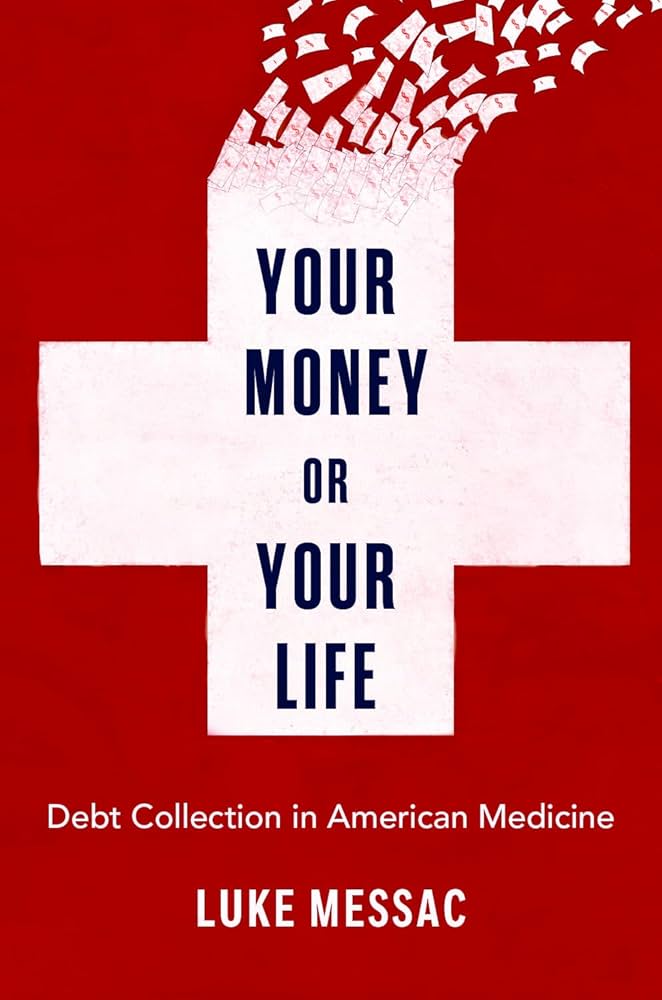
In Your Money or Your Life: Debt Collection in American Medicine (Oxford University Press, 2024), the emergency physician Luke Messac casts a cool analytic eye on the structural conditions that have prompted hospitals to act as debt collectors (or to farm their debts out to collection agencies). But he also writes in a more personal vein, examining his own potential complicity in the debt crisis.

When the New Haven exposes were published circa 2003, most medical debt was incurred by patients with no insurance at all. Today, fifteen years after the arrival of the Affordable Care Act, the problem falls heavily on people who do have coverage. Deductibles, co-payments, and narrow networks mean that even people who spend hundreds of dollars a month on insurance premiums can easily find themselves saddled with massive out-of-pocket bills. “If health insurance never brought true security,” Messac writes, “the turn toward high-deductible plans left behind even the pretense of protection.”

How did we get here? The U.S. health finance system is such a complex beast that we could approach that question from ten different angles. Maybe the key moment came in the 1970s, when hospitals began to inflate their core list prices — their “chargemasters” — so they could more comfortably offer purported discounts to private insurers. Maybe the pivotal change came in the early 1990s, when a few collection agencies discovered that they could profitably specialize in medical debt. By 1998, the largest of these agencies, NCO Financial Systems, had annual revenue of more than $100 million. According to one debtors’ advocate quoted by Messac, certain hospitals liked to invest in aggressive collections not so much because they hoped to recoup funds, but because they believed a reputation for debt collection would keep low-income patients from seeking care at their facilities in the first place. “You can’t squeeze blood out of a turnip,” said Dickie Scruggs, “but you can keep the turnip from coming back.”

As a bedside physician, Messac has a personal stake in the debt crisis. In 2019, during his residency in emergency medicine, he decided to look at the behavior of the three hospitals where he was employed. He spent hours poring through courthouse databases, reviewing the dunning letters that his hospitals and their collection agencies had sent to patients. Some patients replied that they lived on meagre incomes from Social Security disability; others said they were shocked by the size of the bills they faced after short visits to the emergency room; others said they’d been misled into believing that all their care fell within their insurance plan’s network. These court records cast Messac’s day-to-day labors in a new light:

To my horror, as I scrolled, I was finding out that for many patients, the most lasting impact of their visit to the ED was not symptomatic relief or diagnosis but, rather, financial disaster. The gentler my bedside manner, the more I would appear as part of the con to the patient who ended up in a courtroom. They would likely not remember me at all; if they did, I might be one among the many people who had conspired, with the lawyers and judges and collection agencies, to squeeze them for whatever profits I could.

Messac acknowledges that individual physicians like himself have little power over hospitals’ prices or debt-collection practices. For that matter, hospitals themselves can’t be wholly blamed for the medical debt crisis, embedded as they are in a health-finance system where private insurance companies walk away with the lion’s share of profit. Messac quotes Melissa Jacoby, a law professor at the University of North Carolina who has long studied medical debt, as arguing that the “hospital misbehavior model” of medical debt reform is badly incomplete.

What kinds of reform — addressing not only hospitals’ behavior but the whole lurching apparatus of U.S. health care — might solve the medical debt crisis? Messac sketches several avenues of reform, at increasing levels of ambition:

Cushioning the effects of medical debt by removing it from credit reports: This strategy might seem like low-hanging fruit, but advocates have struggled with it. The Biden administration enacted a rule that forbade medical debts from figuring into credit scores — but a federal court has struck down that rule. Worse, a few weeks ago the Trump administration declared that state laws that remove medical debt from credit reports should be considered invalid and unconstitutional.

Putting a leash on hospitals’ debt-collection practices: Over the last decade activists have achieved hard-won, small-scale policy changes at the state level. States such as Connecticut, Colorado, and Maryland have enacted reforms that cap interest rates on medical debt and restrict hospitals’ ability to pursue aggressive collections, especially in cases where the debts are relatively small. 

Buying and retiring debt from medical-debt brokers: The last decade has also seen the rise of Undue Medical Debt (formerly known as RIP Medical Debt), a nonprofit organization that purchases tranches of medical debt — typically for pennies on the dollar — and then forgives them.  Municipal and state governments including Pittsburgh, San Antonio, and Illinois have collaborated with Undue Medical Debt and similar groups to dissolve more than $15 billion worth of obligations.

Straight-up canceling medical debt: A more radical approach would be to declare existing medical debts null and void — either by pressuring hospitals to do so or by passing legislation. That’s the ethos of the Debt Collective, an organization that has recently expanded its focus from student loans to the world of medical debt. A bill introduced last year by Rep. Ro Khanna and Sen. Bernie Sanders would make it illegal to attempt to collect existing medical debts and would remove all medical debt from credit reports.

Preventing medical debt by enforcing nonprofit hospitals’ duty to offer free and discounted care to low-income patients: At an intermediate level is the nascent effort to force nonprofit hospitals — especially the major academic medical centers — to take seriously their obligations to provide what is known as “charity care.” As Messac explains, there has always been an expectation that nonprofit hospitals will provide a certain level of free care and public benefit in exchange for their tax-exempt status. The rules surrounding that obligation waxed and waned over the course of the twentieth century, as statutes and IRS regulations changed. But they became somewhat tougher in 2010, with the passage of the Affordable Care Act. Sen. Charles Grassley, a Republican who generally opposed the ACA, inserted a provision that requires nonprofit hospitals to develop and publicize Financial Assistance Policies, or FAPs, for their low-income patients.

Grassley’s law does not spell out what income threshold hospitals must use to define eligibility for their FAPs, nor does it dictate how generous hospitals must be to the patients who qualify. Even the one hard requirement in Grassley’s language — that hospitals inform eligible patients of the existence of their FAPs — has not consistently been followed. Messac cites a 2022 New York Times investigation of a Washington state hospital system that persistently failed to inform low-income patients that they could apply for charity care. 

Advocates are trying to make the Grassley rule more meaningful. The nonprofit organization known as Dollar For assists patients with submitting the paperwork for financial assistance. This year, the Lown Institute published a database of more than 2500 public and nonprofit U.S. hospitals’ financial assistance policies. They found wide discrepancies in hospitals’ practices, even within the same city. 

Preventing medical debt by abolishing copayments and deductibles: In 2025, even gold-plated high-premium insurance policies can leave patients on the hook for many thousands of dollars in out-of-pocket costs. The idea that patients require “skin in the game” to turn them into cost-conscious, price-sensitive shoppers has always been sketchy — especially given that it’s almost impossible to learn ex ante what a course of medical care will cost.

The LOOP Coalition is a nascent effort to fight for state and federal laws restricting copayments. Right now these policies are moving in exactly the wrong direction. Trump’s HHS has finalized a rule that would allow out-of-pocket maximums to increase by as much as 4.5 percent in 2026. 

Root-and-branch reform: A single-payer system. We could make all of these questions moot if we tore down the entire edifice of private insurance and established a universal single-payer system, free at the point of care. 

In the political climate of 2025, that goal might sound outlandish. Only sixteen Senators have co-sponsored the current iteration of Bernie Sanders’s Medicare for All bill. But things can change quickly. Messac relates a story that the Canadian novelist Margaret Atwood told in her Payback: Debt and the Shadow Side of Wealth (2008). When Atwood’s younger brother was born in Montreal in 1937, the hospital refused to discharge her mother for several days until her father received his paycheck and was able to pay the bill ($99 Canadian). That sort of “hospital detention” was a taken-for-granted practice in Depression-era Quebec — but within thirty years, popular movements won single-payer systems throughout Canada. Since the early 1960s, laboring mothers in Quebec have had no out-of-pocket charges at all.

The U.S. health finance system is broken, and it’s about to get worse. But the Canadian experience reminds us that things can change drastically over the course of a generation. More than half of the U.S. population supports Medicare for All. With enough organizing, the public might someday — sooner than we might think — build enough power to make universal insurance a reality. As Messac writes, “No one has fated hospitals in America to be palaces of plunder. They can be houses of healing.”

Filed Under: Uncategorized

The U.S. Rehab Industry: Hyperpunitive, Careless, Grifting

October 26, 2025 by David Glenn

In the summer of 2015, a twenty-four-year-old Louisiana man named Chris Koon went on a weeklong meth binge. The week came to an end when police raided the house where Koon was staying. He was looking at a five-year sentence for felony possession — but the prosecutor offered him an out. He could avoid jail by spending 18 to 24 months at a residential rehab program known as Cenikor. How could he say no?

Koon, who is one of the four central figures in Shoshana Walter’s deeply reported Rehab: An American Scandal (Simon & Schuster), soon found that Cenikor was unlike any rehab he’d ever set foot in. Participants were woken up at 2 am and told to scream at each other for minor rule violations. Actual counseling was minimal. Instead, Koon and the other participants were farmed out across Louisiana as low-wage laborers. In his time at Cenikor, Koon worked as many as 80 hours a week in restaurants, chemical plants, and a grain silo. Cenikor pocketed all of his wages; Koon was given three packs of cigarettes a week. When Koon tore a rotator cuff in an accident at a spice plant, he was told that he’d need to leave the program and go to jail if he wanted medical attention. “The work is not optional,” a director told him. 

When the Affordable Care Act kicked into gear in the early 2010s, a flood of new resources became available for treatment of substance use disorders. Private insurance plans were now required to offer at least limited coverage for addiction treatments, and new streams of money became available through Medicaid. But, as Walter painstakingly explores in Rehab, the post-ACA era of addiction care has fallen far short of its potential. Tens of thousands of people who need help are being steered into programs that are hyperpunitive, careless, grifting, or all of the above.

Part of the problem is a lack of state capacity. Even as new public money has poured into addiction care, state and federal governments have failed to build a regulatory apparatus that can keep an eye on providers. According to Walter, residential-rehab operators in California aren’t required to have any domain-specific expertise. At one point, the state had only sixteen inspectors to monitor more than 2000 licensed rehab centers. Beyond the licensed residential centers, there is an even less regulated tier of “sober-living homes,” many of which are excellent, but some of which rake in Medicaid reimbursements while completely neglecting their residents’ needs. (The Baltimore Banner won awards this year for exposing an especially sketchy operator.)

If underregulation is part of the problem, addiction treatment in the U.S. has also been hamstrung by overregulation. As Walter demonstrates, the federal government was for many years far too cautious about allowing primary care physicians to prescribe Suboxone, a medication that effectively helps people wean themselves from opioid addictions. Where France and other countries made Suboxone and similar medications broadly available via prescription, the United States put up barriers. Doctors who wanted to prescribe Suboxone had to obtain a waiver by completing a lengthy training. Until 2022, they were permitted to prescribe the medication to only a limited number of patients. Because there were too few providers to fill the public’s need, some people living with opioid use disorders started to buy Suboxone on the black market to help ease their withdrawal symptoms. This illicit trade in Suboxone in turn drew the attention of the Drug Enforcement Administration, which started to show up at Suboxone prescribers’ offices, demanding to see their patient records.

Walter tells this story in part through the figure of Larry Ley, an eccentric Indiana physician who, along with his practice’s entire staff, was arrested in 2014 and charged with dealing in a Schedule III controlled substance. Indiana authorities claimed that Ley and his colleagues had sloppily dispensed Suboxone without properly validating their patients’ addictions or offering them counseling to assist with recovery. Ley was eventually acquitted at trial, and the charges against his colleagues were dropped. But at that point he was a nearly broken man: While awaiting trial he had picked up a couple of DUI arrests and had lost his medical license. 

In her account, Walter concedes that some of Ley’s clinical choices were sketchy. “And yet,” she writes, “the sad reality of the treatment landscape meant that he had still done a better job of facilitating his patients’ survival than many other treatment programs.” Ley’s instinct to put Suboxone in the hands of as many people with opioid use disorder as he could was a correct instinct. 

Meanwhile, even after the federal government’s belated 2022 liberalization of Suboxone, the law continues to treat the medication as a threat. As Walter reported in a separate project this summer, newborn infants are still sometimes removed from their mothers’ care if Suboxone is detected in their system, even if the Suboxone was properly prescribed for addiction treatment. 

Many lives have been needlessly lost over the last twenty years because of the slow rollout of Suboxone. That’s not solely a story of federal misregulation. Suboxone’s manufacturer didn’t help matters, Walter argues, as it sometimes behaved as if it were more concerned with extending its patents than with getting the drug into the hands of all the people who needed it. And even if federal regulators and drug companies had acted pristinely, there would still have been an uphill battle to persuade primary care providers to make addiction care a routine part of their practices.

Chris Koon, the Louisiana man who was forced into what amounted to indentured servitude at Cenikor, eventually caught a break. After two years of exhausting labor, he was kicked out for alleged noncompliance with house rules (at just the point when he had logged enough months that he would have been allowed to keep some of his wages). This was a bad moment. Having “failed” Cenikor’s residential rehab program, Koon could have been forced to complete a five-year jail term. But a judge took pity and allowed him to go into supervised probation instead. As of the end of Walter’s narrative, Koon had started a family and was maintaining sobriety, in part with the help of Suboxone.

Cenikor is hardly the only rehab program to have been accused of exploiting participants for cheap labor. As Walter reported elsewhere, the Salvation Army has been sued for similar alleged malpractice. Rehab operators can milk the system in other ways, as well: They order huge numbers of urine toxicology screens for which they’re amply reimbursed (the tests are known in the industry as “liquid gold,” Walter tells us). In some cases they also have financial incentives to overmedicate their residents. Walter relates the story of two patients who died within a short span of time at a California rehab center after being given absurd cocktails of multiple sedating medications.

The story of the U.S. rehab industry across the fifteen years since the ACA’s enactment gives us more proof, if any were needed, that access to health services is not enough. A universal health insurance system — if we should ever get there — won’t be enough. In addition to a generously funded treatment system, we will also need robust oversight that places patients’ voices at the center. If a rehab center exists mostly to exploit its participants for low-wage labor, the state should have the capacity to shut it down. If government regulations are denying people access to actually-effective interventions like Suboxone, it shouldn’t take decades for the system to correct itself. In addiction care, as in every other kind of health care, the system needs to be built around patients’ actual needs. 

Filed Under: Uncategorized

The American Health Empire, 55 Years On

September 14, 2025 by David Glenn

In the last fifteen years of her life, Barbara Ehrenreich revisited one of the central subjects of her early work: the maddening experience of being a patient in the United States. Medical paternalism had been the focus of her early collaborations with Deidre English: Witches, Midwives, and Nurses (1972), Complaints and Disorders (1973), and For Her Own Good (1978). Decades later, after her cancer diagnosis, Ehrenreich revisited that terrain in Bright-Sided (2009) and Natural Causes (2018).

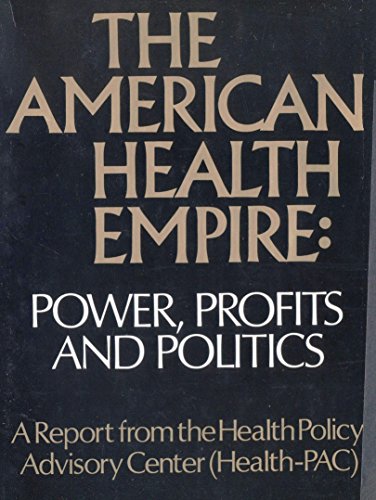
I knew all of those books — but until recently, I’d never read Ehrenreich’s earliest jeremiad against U.S. health care. The American Health Empire: Power, Profits, and Politics (1970) was written with her then-husband, John Ehrenreich, on behalf of the Health Policy Advisory Center (Health-PAC), a New York City think tank where both worked for a time. (Several chapters were co-authored by other Health-PAC staffers.) 

Reading the book in 2025 offers some dismal reminders of how little has changed in the last half century. American health care, the Ehrenreichs wrote, was fragmented, unaffordable, unaccountable, inaccessible, and severely distorted by profit motives. But even as its core critique feels all too timely, The American Health Empire was the product of a very different moment. 

In 1970 it was taken for granted that universal health insurance would soon be achieved, one way or another. The labor eminence Walter Reuther was promoting a model that was broadly similar to the Canadian single-payer system, while the Nixon administration was floating its own, more industry-friendly model of national insurance. In either case, the problem of uninsurance seemed sure to be solved within a few years. 

The Ehrenreichs were unimpressed. The American Health Empire regarded the apparently imminent achievement of universal insurance as a “great leap sideways” that would do little to remedy the crises of access, fragmentation, overtreatment, paternalism, and racism. Universal insurance was not enough. Only a fully nationalized system such as the U.K.’s National Health Service, the Ehrenreichs held, could address the fundamental injustices of U.S. health care.

“Not merely the funding of the health system, but the system itself must be public,” they wrote. “It then becomes possible to face such questions as how such a ‘national health system‘ can be made responsive to the community and accountable to it.”

Halfway measures such as Medicare and other Great Society programs were likely to do as much harm as good, the Ehrenreichs wrote. Just look at how New York City had allowed the post-1965 flood of money from Medicare and Medicaid to degrade its postwar system of public health clinics and public hospitals.

That might sound like a paradox. Shouldn’t all that new federal money in the late 1960s have improved care, on net? The Ehrenreichs’ critique ran as follows: The new federal programs reimbursed far more generously for inpatient treatment than for any other setting, and this created incentives that favored huge hospital centers at the expense of neighborhood clinics and primary care. Much of the money was vacuumed up by rapidly rising physician salaries and by vendors of hospital equipment; some of it flowed into Columbia University’s real estate empire. Health care inflation spiked severely in 1968 and 1969. 

In sum, it was no easier — if anything, harder — for working-class New Yorkers to access and afford their care in 1970 than it had been a decade earlier. “The city has less to offer,” the Ehrenreichs wrote, “to fewer people and at greater cost, than at any other time since the Depression.”

All of this was unfolding alongside the civil rights revolution. Patients and radical clinicians in New York were fighting not only for access to affordable care, but also for dignity and respect. The American Health Empire includes vivid portraits of several strains of New York activism in 1969: Mental health workers occupied and took control of a clinic in the South Bronx. A union/community alliance demanded changes at a municipal clinic on the Lower East Side, calling for investments in “diseases whose victims usually never arrived at the health center — diseases like narcotics addiction and lead poisoning.” Med students at Columbia gave patients in their own waiting rooms leaflets about the Columbia-Presbyterian system’s racist neglect of the Harlem community.

With benefit of hindsight, we can say that the Ehrenreichs were much too hopeful about what those neighborhood actions might add up to. The book contains several hand-wavy passages implying that an unstoppable movement for fully socialized health care must be just around the corner. (“The chances are that both the movement and its program will grow explosively in the next few years.”) But even if their interpretations were too expansive, it’s still bracing to read the Ehrenreichs’ accounts of patients and clinicians taking risks together to will into existence a health system that would respect human dignity.

One curious thing about The American Health Empire as an artifact is that it’s highly New York-centered (no shame in that — it was the product of a city-based think tank), and yet packaged as an indictment of U.S. health care writ large. Maybe some editor at Random House decided the book would sell better if it were framed as an Unsafe at Any Speed-style national expose. Most of the book’s attacks on paternalism, overtreatment, and general indignity did (and still do) apply to the entire country. But in at least one respect, New York was crucially different from almost everywhere else in the United States. Only New York and a handful of other cities had strong networks of public clinics and public hospitals in 1965. In the vast majority of the U.S., the arrival of Medicare and Medicaid did indeed profoundly expand low-income people’s access to health services. In that respect — especially given how little further reform there’s been in the last half-century — the book’s relentless critiques of federal programs sometimes feel off-key.

From the standpoint of 2025 — with 7.9 percent of the U.S. population still uninsured; with another 7.5 million people now facing the loss of Medicaid under the Trump budget; and with the ACA markets under severe strain — the policy climate of 1970, when universal insurance briefly seemed inevitable, might sound a little like paradise.

It wasn’t. The Ehrenreichs may have underappreciated the importance of securing universal insurance, but The American Health Empire includes many reminders of why the U.S. health system will still require profound change even after everyone is insured. If you’re tired of well-intentioned seminars couched in the tepid language of “health disparities,” the root-and-branch radicalism of this fifty-five-year-old book might be the tonic you need.

“No one is interested in reshufflings and repackagings of the same old fragments,” the Ehrenreichs wrote. “No one is interested in renovating a building which ought to be condemned. . . . When the priorities of the health system have been reversed, then it will make sense to discuss the niceties of hospital planning, or clinic administration, or group practice design.”

Filed Under: Uncategorized

Primary Sidebar

  • The Adverse-Decision Machine
  • Insult to Injury: The Ongoing Crisis of Medical Debt
  • The U.S. Rehab Industry: Hyperpunitive, Careless, Grifting
  • The American Health Empire, 55 Years On

c.v.

On Ellen Willis (1994).
On Jedediah Purdy (1999).
On vaccine development (2004).
On Bayard Rustin (2004).
On Philip Rieff (2005).
On Josh Marshall (2007).
On Mary Heaton Vorse (2007).
On attention and multitasking (2010).
On Carol Rosenberg and the Guantánamo beat (2010).
On undergraduate business education (2011).
On solitary confinement (2017).
On Ronald Epstein and attention to patients (2018).
On clinical misery and peer support (2018).
On the COVID pandemic in Florida (2021).

Blogroll Like It’s 2005

Crooked Timber

Health Affairs

Health Care Renewal

Lown Institute

Nursing Clio

Retraction Watch

Somatosphere


Copyright © 2026 · Metro Pro on Genesis Framework · WordPress · Log in